
What an AI agent can do on LabMission
Any agent that speaks the Model Context Protocol can sign in to your workspace, read it, query and stream its data, and draft new integrations, queries and dashboards. Each change it drafts is a proposal that a person approves. Everything an agent does, your team can also do by hand.
- 01get_workspace_flow→14 nodes · 2 surfaces · 0 pending
- 02list_data_connections→Freezer B, PR-2, Courier tracking
- 03run_warm_queryfreezer_temps_24h→1,440 rows
- 04tail_telemetryfreezer-b · 60 s→60 readings, live
- 05manage_proposalscreate→#128 awaiting review
- Signed in as agent · rights: Biobank operator (read) + propose
One governed door for every agent
The MCP server is how an agent reaches LabMission. It signs the agent in, applies the rights you gave it, and records every call. Behind it, the agent works with the same workspace your team uses.
Six things an agent does, and an example of each
Read the workspace
get_workspace_flowSees every connection, query, surface and agent, how they connect, and what proposals are pending. Secrets are stripped before it sees anything.
Find data sources
list_data_connectionsLists the instruments, sensors and systems already connected, so it builds on what exists instead of duplicating it.
Query the data
run_warm_queryRuns your named queries, or writes its own in KQL, over the data your lab is producing.
Watch a live stream
tail_telemetryFollows readings as they arrive, for up to five minutes, filtered to one connection or one surface.
Pull history
download_cold_dataExports a time range as CSV or JSONL for analysis, a report or a downstream system.
Propose a change
manage_proposalsDrafts new connections, queries, surfaces, data stores, API sources and access rights as one proposal. This is the agent's only way to change anything.
Agents also read the API's OpenAPI spec, filtered to what they're allowed to call, plus a schema and worked examples for every kind of node they can propose.
An agent builds a freezer-monitoring integration
A biobank manager asks for alerting on a new ultra-low freezer. The agent does the building and the manager makes the decision.
- 1You
Ask in plain language
"Freezer B's new sensor is online. Alert the custodian when it rises above -70 °C, and show which samples were inside."
- 2Agent
Reads what exists
Reads the workspace, finds the sensor's connection, and tails a minute of readings to learn their shape.
- 3Agent
Drafts the change
Proposes a query for excursions, an alert on that query, and a panel on the storage dashboard, each with its reason.
- 4You
Review and sign
Read the proposal as a diff, adjust the threshold, and approve it. Where your process needs a second approver, it waits for them.
- 5LabMission
Deploys and records
The change goes live. The proposal, the approval and the signature are hashed into the record.
- 6Your lab
Excursions reach the right person
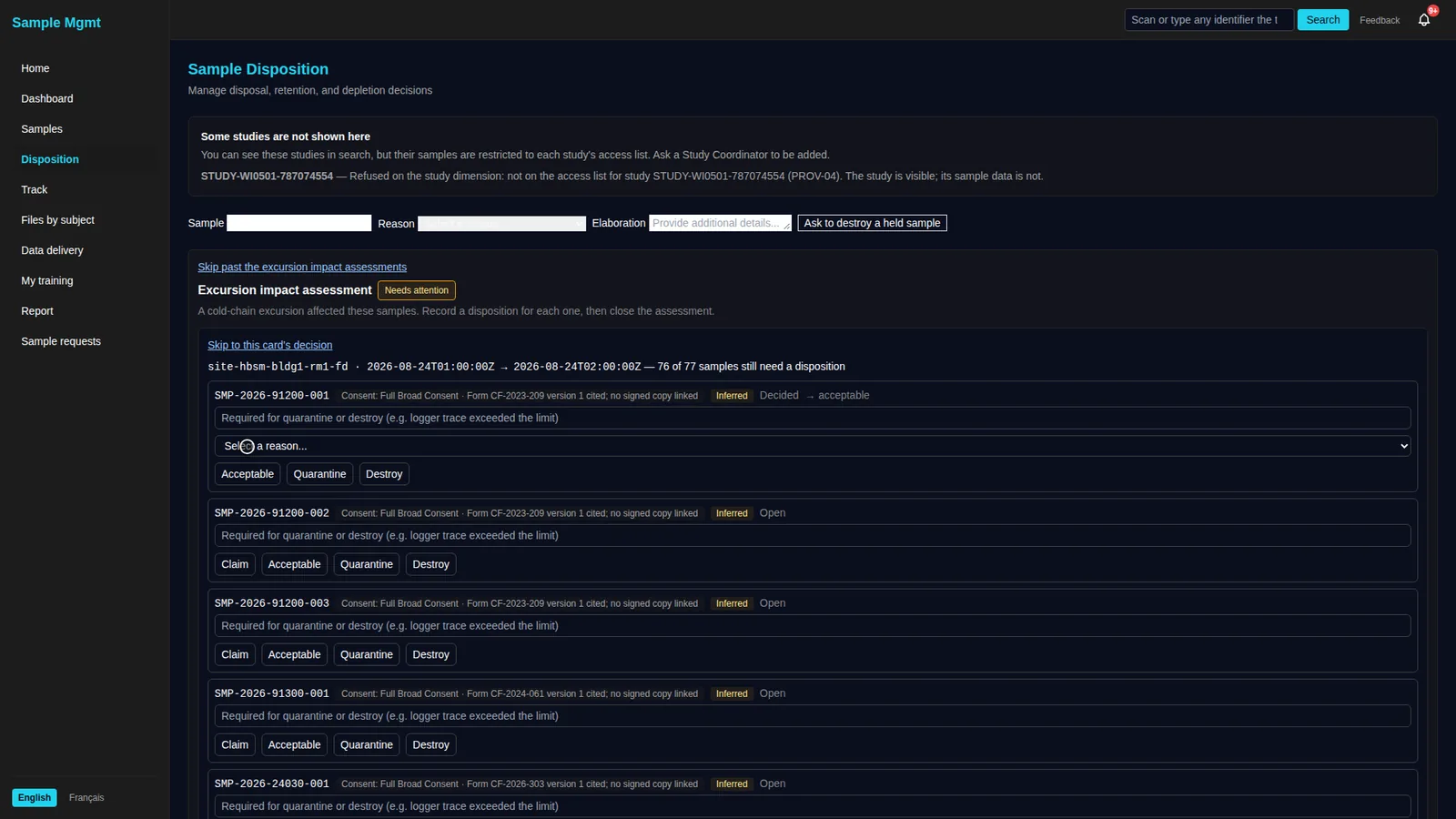
The next excursion opens one impact item per tube in Sample Management, for the custodian to claim and decide.
- + query freezer_b_excursions
- + alert Custodian, on each excursion
- ~ surface Storage dashboard (adds 1 panel)
Integrations and tools a lab asks for
These are the requests agents handle well, because each one is built from parts the platform already has.
Instrument integrations
A connection for a reader or robot, the column mapping for its export, and a query over its results.
Cold-chain monitoring
Sensor connections, excursion queries and alerts that resolve to the samples that were exposed.
Courier and partner feeds
An API source that polls a courier or partner on a schedule, so expected arrivals reach reception.
LIMS and ELN bridges
A connection that receives events from systems you already run and lands them on the same record.
Study dashboards
Surfaces and interfaces over the queries a study team watches, published for the people who need them.
Workbench code
The code for a workbench, such as a label service or a calculation, proposed and deployed like any change.
Access proposals
Draft access rights and role configurations for a new team, for an administrator to accept.
Analysis extracts
Time-bounded exports and published queries for statisticians, data scientists and downstream tools.
The same rules for agents as for people
- An agent signs in with OAuth and holds only the rights you grant
- It reads through those rights, and secrets never reach it
- Its only write is a proposal; a person approves, changes or rejects it
- Approvals can require a reason, a signature and a second person
- Every call and every change lands in the same provenance record
- AI arrives switched off and runs on your own AI service when you turn it on
Watch an agent build on LabMission
We'll connect an agent to a workspace, have it draft an integration, and walk the proposal through review, signature and deployment.